13.8.12

434km Cycling Up & Down Sichuan Mountains

On leaving Shangri-La mid-June we spent 10 days touring the mountainous region of Sichuan, in West China. We had initially planned & paid for a cycling trip from Lhasa to Kathmandu, yet only one month before our flight to Tibet we discovered that the Chinese created a new rule - stating that all foreign visitors to TAR have to be in groups of 5 or more & all must be from the same nation. This destroyed our plans making us deeply upset, so we therefore decided to spend the next month cycling around the Sichuan province in China; planning to visit the North & South Tibetan Highways, which we were hoping would give us some insight to what Tibet is like.


Majestic Mountains
We spent the last couple of weeks in June cycling up & down the foothills of the Himalaya mountains in the Sichuan province in China, along the border of Tibet. Our highest mountain pass was at 4652m. Some of these rides through the bare mountains at 4000m+ altitude have been our best rides yet, although none of them were easy. Breathing became trickier as the air got thinner (I troubled Sertx by taking breaks every couple of kilometres just to have a semi-asthma attack and get enough air into my lungs,) and the days became shorter as it started to rain every afternoon, with dense fog covering our views. 
 
The temperature also decreased dramatically; I was pulling my windproof jacket, arm-warmers, gloves and ear-covers on & off about 5 times per hour whilst cycling (annoying Sertx who would just deal with sweating profoundly in his jacket); riding uphill became uncomfortable. Luckily the Chinese make good fakes; I bought a North Face winter jacket in Shangri-La, which works better than my non-waterproof Gore-Tex jacket. Some days we cycled just 20 or 30km up a mountain to get over another mountain pass at over 4000m altitude, then descend 20km and 1000m into a warmer valley, where we would rest the night before starting another 1000m mountain climb the following day.

The landscape was stunning. There were whitewashed stupas dotted everywhere and the locals had hung strings of colourful Tibetan flags between shallow mountain peaks in villages and also across rivers. Every beautiful Tibetan-style house we saw also had a big red Chinese flag on display, which made us question whether these were really Tibetan or just recently built for Chinese tourists. We finally used our tent and camped a couple of times, taking care to wait until it was dark so no one could see us; although we were always found in the morning by the farmers who walked their cattle across the fields. 


We also spent nights in rooms with no running water; no sink, no toilet, no shower; having to use the ‘street-tap’ and wash in front of the whole village, often in the rainy weather. There was one occasion when Sertx asked where the toilet was, and the man of the place we were staying in replied ‘go off the balcony’. We saw many pigs, dogs, goats and yaks in the mountains; and we awkwardly also met the dogs & pigs in the village toilets. 
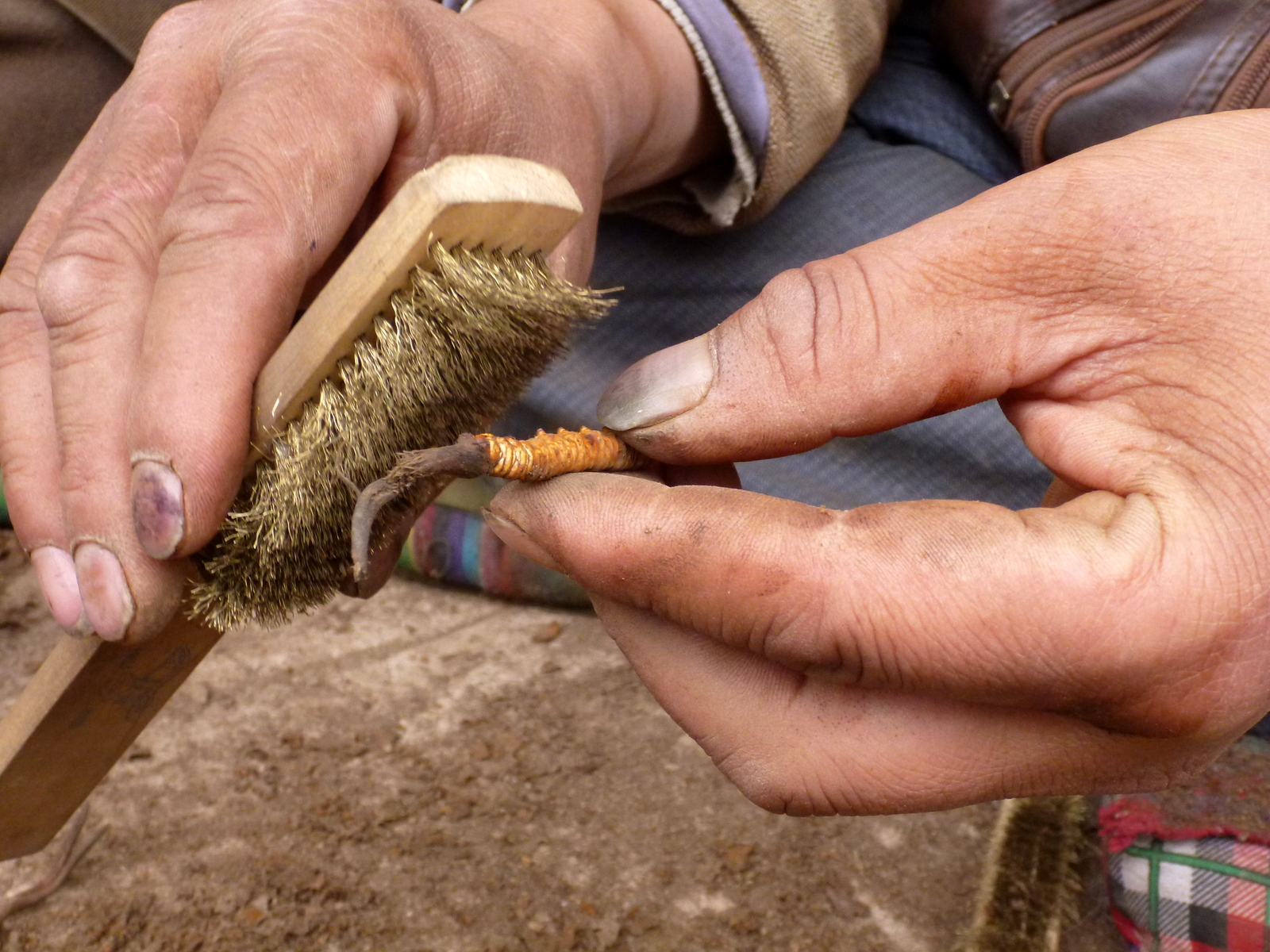


We tried ‘butter tea’ which tasted like oily tea straight from a yak’s udder, and we ate momos, small Tibetan semi-fried dumplings filled with either vegetable or buffalo meat. We did not try some of the stranger foods on display, such as pig snout or ears, chicken crests or feet or duck tongue. We also saw the locals selling golden root-worms for 10 dollars a worm, which are apparently good for you, after you’ve scrapped all the earth off them with a steel brush.


Tibetan Monasteries 
We visited a couple of monasteries, one in Xiangcheng & another in Litang, and the monks have been the nicest people we’ve met in China so far! In Xiangcheng we watched 4 monks creating a Mandela – using special hand-crafted metal tools which they would bang with the end of a knife to let out a certain amount of different coloured salt. On entering the monastery in Litang we had a group of young monks cycle away with our bikes for 30 minutes. They were so excited until one of them got their red dress caught in the chain. 

Both monasteries were spectacular, with large detailed, colourful paintings of Buddhas & demons covering all walls inside & out. The monks even congratulated Sertx on his big beard and several of them asked to be photographed together with him, little did they know it was his birthday, so he was happy to get the compliments. In Litang we were also invited to watch the monks pray, with their big yellow Mohican-like hats on.


Otherwise, the local men continue to play board games at their local restaurants, whilst the women continue to work in markets or restaurants or even on construction sites. At least they have a daily exercise get-together after a day’s work, in the main square or park, where you can see groups of 30 or more woman dancing in sync together to music blaring from a stereo speaker. The locals also spend lots of time turning prayer wheels at their town stupa.


Under Construction
There is construction going on in every city and town we’ve gone through & stayed in. A new highway is also being built right across the province – which results in many heavyweight trucks passing by us on the roads. These trucks, and also motor bikers, would beep their horns so loud it felt as though our ear drums had burst. They weren’t honking at us – they were just doing what felt absolutely normal to them- honking for about 1 minute before & continuing after turning a bend in the mountain. We cycled by several earth & rocky landslides, thinking ourselves lucky not to have experienced one, yet we’re both hard-headed Cancerians so it would have been fine anyhow!

We didn’t expect Litang to be a town under construction, yet on arriving the town was loud, dusty and all the roads were being rebuilt. It wasn’t exactly the Tibetan experience we were hoping for. There was also no bank for foreign credit cards in Litang so we had to head to a city, rather than continue our planned route to Garze on the North Tibetan Highway. 


The South Tibetan Highway was not all we assumed it would be. We were fortunate that we decided to take a 15 hour minivan ride to the next city instead of cycle the whole way; which involved another three 3000m+ mountain passes. It had rained the last week and as the road was under construction it became a massive thick mud-bath that even the buses & 4WD’s had trouble crossing. This was the bumpiest and slipperiest ride we’ve ever had, let alone being the longest in a minivan. The ride also destroyed the soft parts of our bicycles, which were strapped upside-down on the roof for the journey. The day after this we chose to endure another 8 hour bus ride into Chengdu, from where we would take a plane out of China.

Chengdu chaos
Strangely, we found the city cleaner and quieter than the towns in the mountains, yet the mosquitos were back & biting again. The mountains were disappointingly littered with green, glass beer bottles and red ‘Panda’ cigarette packets in every corner, yet we found the people there more welcoming to tourists than in the busy city. We also got a bit tired of hearing the locals’ constant throat-clearing-spitting and seeing them with their fingers all the way up their nostrils before inviting us to their restaurants, so we felt it was our time to leave. On our last day we decided to take a cab to visit the Panda Breeding Centre, yet the driver drove us in the opposite direction; after we complained because we knew what he was up to, he only said sorry before speedily driving - like in a computer game - through traffic making us sick as parrots and wanting to get out so he got his money & we didn’t get to where we want to go. However, we got to see the famous pandas in the end, by taking a minivan tour and otherwise we quite enjoyed cycling through Sichuan!

15.7.12

Cycling through Yunnan

Yunnan, known for its tea and rice-terrace fields; banana & teak tree plantations; wild edible mushrooms; spicy food, spitting locals & stinky toilets; colourful traditional clothing; beautiful Dai, Bai & Naxi villages, & totally enjoyable, gradually inclined mountain roads with magnificent valley views.

Landscape
The entire Yunnan province is stunningly beautiful to cycle through. We’ve been through national parks, botanical gardens, up quiet mountain paths & through some ancient villages too. The mountain roads are incredibly gradual in inclination, making the uphill cycling last a lot longer yet feel completely painless as we zigzag our way up, only to descend the other side again, in front of yet another climb. The mountain views are breath-taking, their peaks are covered in snow and their slopes packed with lush green vegetation so delicately prepared and cared for.


We have seen neatly organised terraced rice fields & carefully cut tea tree plantations, and we’ve watched how the locals grow, clean and collect their crop from their vast land. The women tend to work in the fields more than the men; we've spotted the men in the local restaurants & bars playing games all day long whilst drinking bottled beer. Women even get to work on construction sites, shovelling sand, stone and throwing bricks up to others to build walls.


We have also cycled alongside the deathly cliff edges of the Tiger Leaping Gorge, where only a thin white painted line separated us from the huge drop. We have visited the White Water Terraces, formed over thousands of years from the deposits of calcium bicarbonate dissolved in spring water. We also spent a night in Shigu, a town by the first 180-degree bend of the 6418km long Yangtze River. The following day we experienced an optical illusion after crossing the river by boat - thinking we were on one side of the mountain which defines the river bend, yet we had somehow already cycled round to the other side; we would be totally lost without our GPS!

We also cycled over a 2950m mountain to an ancient village, Shaxi, known for being on the Ancient Tea Route leading from Yunnan to Tibet. More recently we cycled up to 3722m before a long chilly decent through a green valley with free-roaming yak, goats, horses, ponies and pigs, before reaching the city Shangri-La.


Food
All restaurants here have small stools and short-legged tables, making us need to crouch in a typical bicycle-position, over our bowls to eat. Our knees go through torture sitting on these short stools, often being banged into the table edges, yet the variety of food on offer allows us to forget these little burdens. 


The food ranges from dumplings small & large to different meats cooked in garlic or chili together with an assortment of green leaves; we have also tried yummy dairy products from goats and yak. There are also sadly a lot of flies in this part of the world and we spend much time flapping them away from our bowls of rice or noodle soup in order to enjoy the food fully.
In one of the last mountain villages we visited, before arriving in Shangri-La, we ate in someone’s house together with many men who slowly wandered in, expecting to be served their noodle soup, as usual. After attempting to make conversation with one of the locals we were asked to follow him through the village. We walked through the dark and were stunned to suddenly come upon 100 men in black & red costume, dancing to their local anthem in a basketball court. We sat and watched them all dance in rhythm at the same time, yet during their breaks it seemed like we stole the attention, being the only white people there. 


Noise
The Chinese are not short of being the noisiest people on the planet. They speak loudly to their companions only centimetres in front of them; they talk loudly on the phone; they beep their loud car, motorbike & truck horns - so loud we needed to cycle with rubber earplugs for a week; (we feel we might become deaf before we return home.) They are loud in hotel corridors, slamming doors or laughing in conversation with their companions, not seeming to realise they are in a hotel where others might be resting.
Not only do the drivers honk loudly, they also drive like suicide drivers; on leaving the city Lijiang we saw several accidents as drivers continuously attempted to overtake without looking – even just before corners, or even moving out to find themselves right in front of a car driving in the opposite direction. They never look out or back when turning into a main road & just don’t pay enough attention to others on the road! The only thing that keeps them quiet is smoking massive bongs, which the men here do most of the time!


Architecture
The most spectacular part of the Chinese Yunnan buildings is their decorative tiled roofs. We have seen styles from the ethnic minorities; Dai, Bai, Naxi and also Tibetan. The traditional Yunnan house always opens to a courtyard space, around which the living rooms are organised. The toilets are often nowhere to be seen.. so if you’re ever looking for one in this part of the world, try listening out for the snorting of a pig, as the toilets are always right beside the pig huts!

We’ve cycled by some picturesque Bai houses in the Dali region, all made from brick and wood, with white-painted walls and hand-painted scenes in blue, depicting dancing people, local nature, birds & animals. We have also seen Naxi handmade wood houses in the mountains. Now closer to Tibet we see more clay-brick & mud-made houses, with exterior walls which slant inwards like those of a pyramid. Even the windows of these houses have a slanting frame imitating the walls. We have also seen many colourful temples, old & new, with fabulous layers of roofs painted in reds, greens & blues. 


We have met a few Chinese cyclists on the way; all heading to Tibet of course and making us terribly envious as a result. We cycled a couple of days with some single cyclists we met; our Greek friend Petros, a French girl called Agnes and an Irish lad, Robert, whom you can easily spot in our photos!

Cycling through Yunnan is so relaxing when passing by the mountains or along rivers. We only wish we could inspire you to come and do the same.

13.7.12

Cycling through Central Laos & Northern Thailand

We spent a week cycling around central Laos visiting some famous caves, including the 7km long Konglor cave, which you should definitely go see if you ever visit Laos! Our way of getting there was by cycling & pushing our bikes up & down some very narrow and steep muddy trails and streams, whilst passing the occasional remote village, rice fields & grazing water buffalos. As Sertx was cycling down one of the paths, a young girl pulled out her machete just to show him that she was not scared of the bearded man (the villages were that remote!) 
Once we arrived at the cave we needed to spend another 2 hours convincing the boat drivers to take our bikes on their small, narrow boats for less than the usual bike price, which always seems to be as much as a ‘person’ ticket. We guess they weren’t happy with the outcome, as Sertx’s bike was dropped & sunk into river! The boat ride lasted an hour, which included having to get out and walk in complete darkness across shallower sandy parts a couple of times. Only the boatmen had powerful enough head torches to light-up the vast cathedral-like cavern. This cave was really an unforgettable experience and unfortunately the only place we could not take any photos as it was pitch black inside. 

 
Our Greek friend Petros caught up with us for a day here after cycling through the country on muddy off-road tracks, on which he continued after leaving us, only meeting us again in Laos. We stuck to the asphalt road, cycling passed tobacco-leaf fields in valleys, and up some very steep mountains only to descend their other side steeply, all on our way to the capital Vientiane, from where we crossed over the Mekong into Thailand. Whilst crossing the ‘Friendship’ Bridge I somehow, inadvertently managed to get my front tyre stuck in a train track, thereby flying off and over my bicycle for the first time.
The beautiful tobacco fields of Konglor
 
We spent the first 2 weeks of May cycling through Northern Thailand; One week on undulating roads following the Mekong westwards towards Uttaradit & the second week resting in Chiang Mai then cycling over a few mountains back into Laos again. We thoroughly enjoyed riding these peaceful roads until our third 100km-day where we met some seriously, illegally steep mountain roads that we were forced to get off the bikes & push them up the more than 12% inclined slopes.


We were gratefully rewarded with stunning valley views for every mountain we climbed, however, some massive, biting horseflies managed to catch up with us on our last slope of the day, resulting in us rapidly hopping back on our bikes & spinning our pedals as fast as we could, whilst they flew into our eyes & ears & even tried to nest in Sertx’s beard. Sertx looked like a human windmill trying to fight the horseflies away. 


Although most days on the bike were spent cycling under the intense heat of the sun, we also experienced cycling through several thunderous rain showers, where we needed to dodge leaping frogs & scuttling crabs on the roads!

We accepted an offer for a lift from a friendly Japanese-Thai local, who drove us over many mountains, and across a few towns in order so that we could catch an afternoon train to Chiang Mai – so that we could spend more time exploring the north before our 15-day visa expired. Even though we rushed it was only after arriving at the station that we discovered that large luggage was only allowed on the 5am morning train; the following morning we also discovered that the 5am train is always 3 hours delayed. 


Once in Chiang Mai we picked up our front panniers & rack pack bag, which were filled with our winter clothes & camping kit for the months ahead. Sertx now carries 28kg on top of his 14kg bicycle & I carry 10kg less than him. So since then I’ve been racing up the mountains in front of Sertx for once, who is only slightly suffering from carrying the heavier load. Riding our bicycles now feels as though we are steering a caravan! 


After crossing the Mekong again, we spent 3 days cycling through 40 degrees C. temperatures over the steep mountains in Laos to our final stop in Luang Namtha. From here we spent a day renting a motorbike to explore a town just 58km away, yet only made it 50km to see a waterfall, before a thunderstorm caught up with us. On this occasion we forget to pack our raingear, and ended up soaked to the bone & shivering on the windy & winding motorbike ride back into town.


Laos is breathtakingly beautiful throughout the country, and would make a fantastic trip if only you have the perpetual patience to wait until the locals understand anything you ask for, even when you ask for it in their own language! As for Thailand; that is a country we would happily cycle through any day again!
I swear I didn't knock that lorry over!

12.7.12

Our Summary of Cycling through SE Asia

We spent February, March & April cycling 4280km through Southern Thailand, Cambodia & Laos.
In Thailand we met Dutch, British & French touring cyclist couples almost daily, all heading the opposite direction to us. In Cambodia we met touring cyclists from Canada, Mexico, Switzerland, Germany, Korea & China. We hadn’t cycled with anyone until South Laos when 3 cyclists suddenly caught up with us, heading the same direction -two of them sharing a bright yellow tandem! So we joined forces & cycled together for a few days then continued to cycle along with our Greek flip-flop friend, Petros.

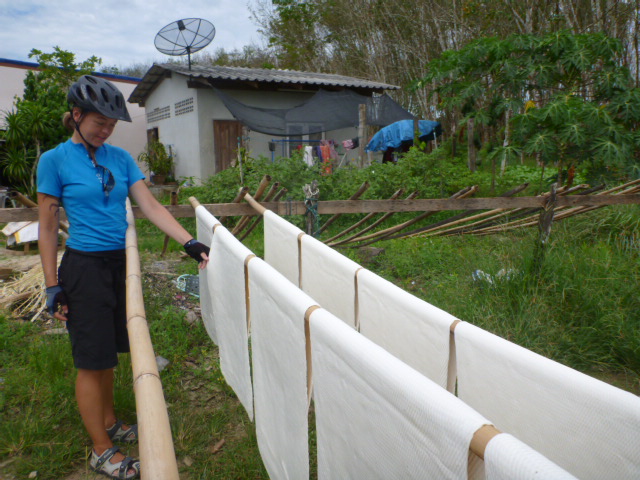
Apart from seeing hundreds of golden Buddhas our trip through Southern Thailand was incredible; we were able to cycle on dirt tracks, (thanks to our GPS) compared to the asphalt roads we needed to stick to in Malaysia. So we have been sliding our wheels through sand, loose rock, dirt & mud, all under a hardcore sunshine and occasionally through a torrential rain shower. We cycled through a trazillion rubber tree plantations, watching the entire process from collecting the latex, to squashing it into flat white sheets, which are then hung over bamboo poles to be dried out in the sun, and then piled onto a lorry and taken to a warehouse, from where they are eventually sent on to China for processing into such uses as bicycle tyres.

We also cycled passed salt fields where the workers wear ‘fonejacker’ woolly masks to protect their skin from the sun! We have also observed how durian, coconuts, pineapples, papaya, bananas & mangos are grown, collected & transported & we also visited a famous floating market in Samut Songkhram where such fruit is sold. There we got the chance to see the Thai princess at an old-style theatre-dance performed specially for her. We also took 3 weeks off cycling to explore the beach islands of Koh Lanta, Koh Tao – where I completed my Dive Leader/Manager course (hurray!) & Koh Samet, where we visited a fishery with Sergio’s parents. We tried a few Thai massages, which Sertx ended up hating, & I had a fifty fish nibble away at my feet, which took some time getting used to. We also ate ice-cream with a mountain bike champion in Don Sak who helped fix my bike brakes.

In Thailand we had cats, dogs, chickens, water dragons, snakes & tarantula-like spiders jump in front of our wheels; in Cambodia it was just the crazy drivers who almost ran us over and in Laos we had larger animals such as cows, water buffalo & goats casually walk into the road making all the traffic stop. We have had dogs tiny & large barking and chasing us as well as locals speeding passed us shouting ‘hello’ from their mopeds & staring back at us in amazement, whilst they continue to drive on. Dogs are born on the roadside & so are used to jumping in & out of the way, just as babies are born riding scooters – we’ve seen kids as young as 5 driving by us!


We did some of our longest cycle days in Cambodia; our lengthiest being 145km, but we also took 2 weeks off in Siem Reap to see the Angkor Wat temples, visit a crocodile farm, see 3 Child Dream Schools & also get both our bicycles serviced. We got to cycle alongside students cycling to school, as well as forest fires and some maniac Toyota Camry drivers and also heard a few too many children screaming ‘hello’ endlessly. Thankfully there are no dead animals on the road, the reason, which we came to discover, was that they throw almost anything on the barbeque! We watched some incredible sunrises & sunsets over the Mekong River & also went on a boat trip to try and spot an Irrawaddy dolphin.

Laos is breathtakingly beautiful. The roads are better than in Cambodia, & they have road signs & speed limits, unlike in Cambodia. We have seen more concrete houses, rather than just tree leaf huts; more babies wearing clothes rather than walking around naked; women wearing normal clothes, not colourful pyjamas all day long; and less screaming kids - families having 2 kids, not 6. However, here no one speaks a word of English, unlike in Cambodia where the locals understood our sign language. Here in the south, we have cycled through sandy islands along the Mekong, passed coffee bean plantations in the mountains, and swum in some mega big waterfalls.


We were in Laos for the Asian New Year which coincided with the week-long water festival - where the locals were drinking too much alcohol & throwing buckets of water at us cyclists from the side of the road, rather than lying calmly in their hammocks as usual. We also changed our road tyres to 2-inch-wide off-road ones to cycle 1324m up to the Bolaven Plateau to visit some beautiful waterfalls. Only days after we were cycling & pushing our bikes through a jungle terrain along the rocky Ho Chi Minh trail which was the hardest thing we’ve ever done. In this off-beaten track we found an American tank and saw local villagers exchanging metal war junk for Vietnamese sweets!


I’ve experienced head pains, tummy pains, muscle pains, knee pains and shoulder aches; yet Sertx only feels bicycle pains, becoming frustrated when another wheel spoke snaps, or the inner tube punctures, or the Rohloff hub leaks black oil everywhere, or the tyre is too wobbly to ride with. 
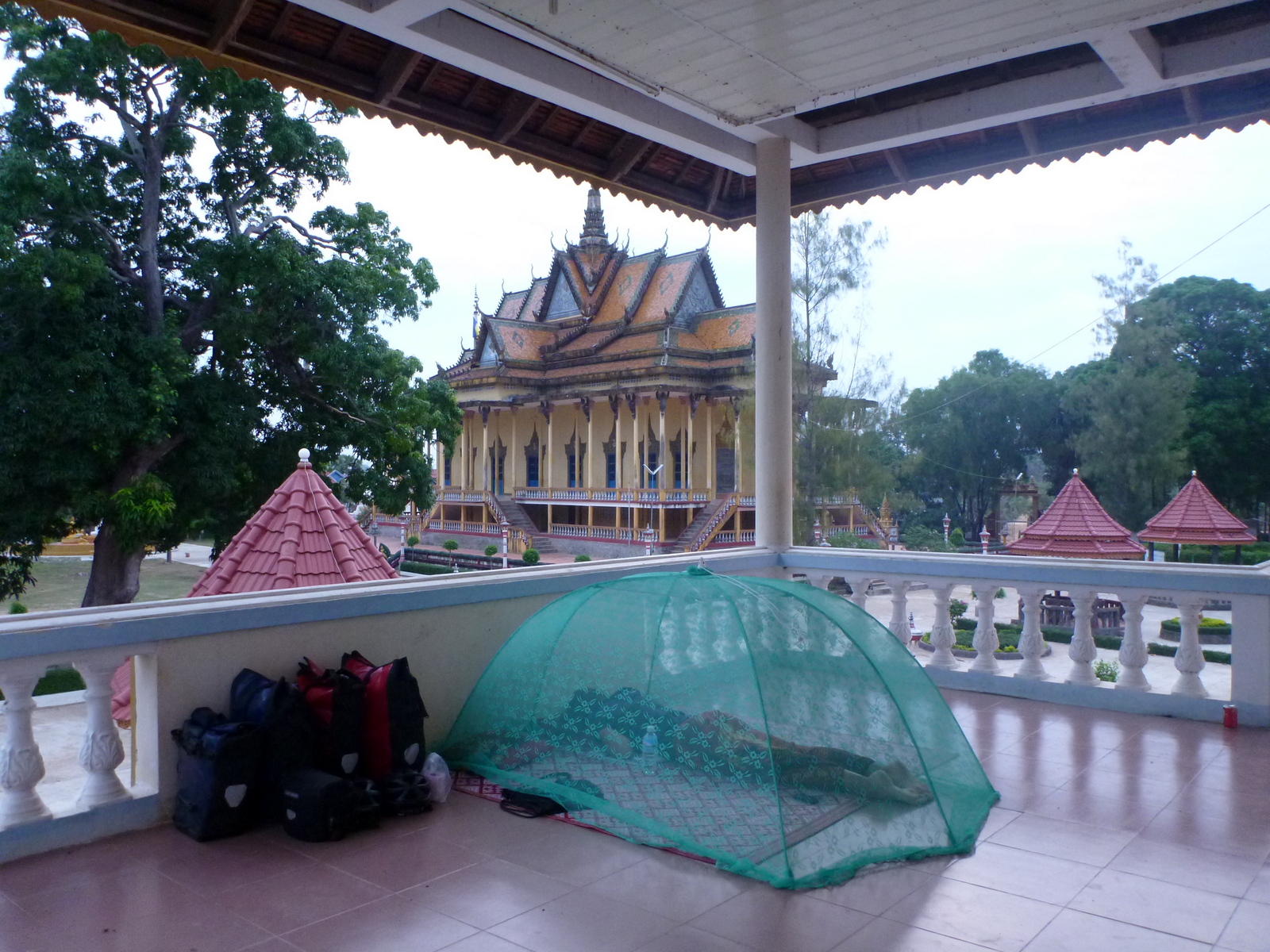
We’ve experienced sleeping in a thin-walled love motel in Thailand, on an ant-infested balcony floor of a monastery in Cambodia, and have also spent a few nights in homestays in Laos, where there is no clean water - having to wash ourselves in a nearby muddy river or from a barrel filled with old water.

This photo was taken by Petros


Our thighs are thinner but our bellies are bigger; I ate lotus fruit in Kratie, whilst Sertx ate a locust in Yan Ta Khao. Every morning the thing we look forward to least is the torture of pulling on our sweaty lycra padded pants, but what we enjoy most is being able to experience time with the funny locals by cycling through their land. Our experience of each country just becomes more insightful & the routes definitely tougher as we cycle on northwards.

Supporting Child's Dream to Build a School in Laos

In March we cycled 140km each day for 3 days to visit 2 schools by Child’s Dream, which were located in the most remote part of northern Cambodia. We cursed our way through sandy paths and off our GPS route through jungle terrain, praying not to be eaten by a tiger in the Kulen Prum wildlife sanctuary we were cycling through. 
We saw the current conditions the children are taught in; the village locals have built small huts out of bamboo & dried out palm tree leaves to act as a classroom under which 200 students need to be taught. During the monsoon months the wind & rain water disturb the lessons and in summer the heat is uncomfortable to concentrate in; all this in a malaria prone area.

The new schools built by the Child’s Dream charity follow government approved construction plans & designs. They are made from concrete, have high ceilings for hot air to rise and large windows for cool wind to ventilate through and altogether provide a comfortable learning environment. Teachers are provided & paid by the government and the schools are also provided with classroom furniture, toilets, a playground, a ground-water hand-pump for drinking water and one school even has a solar powered battery charging station, for producing electricity for use by the village! 


All in all Child's Dream aim to create effective, efficient & sustainable projects whose progress they continue to monitor.

In Cambodia:
45% of children just end up working in the fields for their parents
More than 50% of all school children cannot afford to continue their education after primary school (from the age of 12 onwards)

In Laos:
20% of all villages do not have a school;
Only 15% of the population have completed primary school.

Child's Dream also support a sustainable agricultural project; NEED-Burma. This Network for Environmental & Economic Development project is an attempt to act as a catalyst for progressive change in Burma. NEED's Model Farm Initiative (MFI) is a six month professional development training program in sustainable agriculture, environmental justice, community development & leadership for ethnic minority youth from Burma. The participants live, work & learn at the farm & training facility in order to implement these skills back in their country. We spent a day being shown around the farm, which is located only a short distance from Chiang Mai.

 
We also cycled up more steep side roads in northern Thailand, close to the Laos border, in order to visit one of Child's Dreams nurseries.

Our website has a photo page of all our visits: 
Child's Dream images 

Help us fulfil these children’s dreams!


Thank you to all of you who have already kindly supported the charity through your donation!
To those of you who haven’t (and promised)… - just think that as little as $5 will help support a child.
Please help by clicking on the link and making a donation: www.cyclingarchitects.com/donate


Whilst in Chiang Mai we cycled to the Child’s Dream headquarters and met with the founders, with whom we discussed the options for which school your donations could go. They confirmed that we could choose the country in which we would like the new school to be built, & that it would be possible to monitor costs, construction & follow all building stages, including post completion. 

We are currently in the process of choosing a Secondary School project in Laos. If you make a donation we will keep you informed of the progress over the next couple of years.